


Digital competitors, prediction markets, policy volatility, and agentic AI are re-platforming the state lottery. The winners will look less like paper-ticket businesses and more like trusted, retail-inclusive, omni-channel public gaming platforms.
The material is for educational purposes and does not constitute investment, legal, tax, procurement, or policy advice.
I. Executive Summary
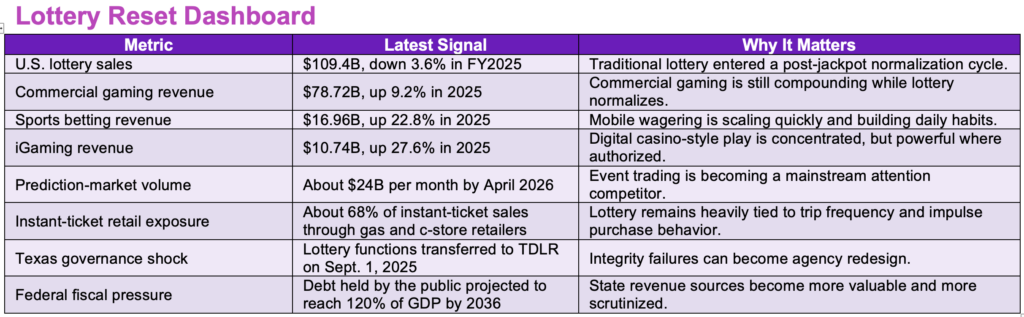
State lotteries are entering a structurally different cycle. The old model, retail distribution, paper tickets, jackpot cycles, and compliance-led responsible gambling, still matters. It is no longer sufficient to drive the next decade of growth. FY2025 exposed the shift: U.S. lottery sales softened after record jackpot years while commercial gaming, online betting, and prediction markets continued to scale. The issue is not that lottery is weak. The issue is that the consumer, the channel, and the competition have all changed at once.
The winners of the next cycle will not simply sell more tickets. They will operate as trusted, retail-inclusive, omni-channel public gaming platforms: digitally capable, AI-enabled, politically fluent, and visibly committed to responsible gambling. Their edge will be the one thing many competitors cannot easily copy: public trust tied to public benefit.
Four forces define the reset:
- The maturity problem. Traditional sales are flat and jackpot-dependent while a K-shaped consumer squeeze and gasoline-price volatility hit the core player in the retail channels where many instant-ticket purchases occur.
- The five-front competition. Sports betting, iGaming, prediction markets, sweepstakes casinos, and gamified financial speculation are training the next generation of players on someone else’s app.
- The trust reckoning. Texas transferred lottery oversight after a bulk-purchase scandal and courier controversy. A single integrity headline can now become a governance reset.
- Agentic AI. AI can help public agencies scale accountability, integrity monitoring, knowledge capture, responsible gambling, and productivity without commercial-scale headcount.
The core implication is simple. The next cycle will not reward waiting for another jackpot run. It will reward trust infrastructure, retail-inclusive digital channels, policy fluency, and AI-enabled operations. The lottery is not dying. It is being re-platformed.
II. What Lottery Leaders and Stakeholders Misunderstand Most
The highest-value shift in the sector is from cyclical thinking to structural planning. Cyclical thinking waits for the next jackpot. Structural planning builds for the consumer, competitor, channel, and policy environment that now exists.
- The next big jackpot cycle will not fix the trend. Jackpots can mask channel migration for a year at a time. They do not reverse it.
- Prediction markets are not only a legal problem. They are a product-design warning delivered by the next generation of players.
- Responsible gambling is not merely a compliance cost. It is the trust brand and the competitive moat that many gray-market, federally preempted, or offshore competitors cannot copy.
- AI’s first job is not marketing. Its first job is integrity, knowledge preservation, productivity, auditability, and responsible gambling.
- Retail and digital are not a tradeoff. Retail-inclusive iLottery is the political design that makes modernization possible. The store must win when the app wins.
III. Is the State Lottery Entering a Structurally Different Cycle?
Yes. The evidence points to a regime change in how lotteries grow, protect trust, and deliver public benefit. The old edge was distribution. The new edge is platform and trust.

The macro backdrop enforces the shift. The lottery consumer is more sensitive to gas, groceries, insurance, rent, and utility prices than the consumer targeted by much of the online betting complex. Tariffs and supply-chain uncertainty keep goods costs elevated. Data-center electricity demand can push household bills higher in some markets. These pressures do not mean lottery is weak. They mean the legacy consumer and channel mix are more exposed.
Operator takeaway. Stop measuring health only by total sales. Track channel mix, price point, cohort acquisition, retailer type, trust metrics, and digital migration.
Policymaker takeaway. Modernization is not mission drift. It is how the public-benefit mission survives a mobile-first consumer.
2027-2031 Forward Look. The cycle rewards lotteries that operate like regulated digital platforms with retail distribution, not product warehouses with websites attached.
IV. The K-Shaped Consumer, the Gas Pump, and the Maturity Problem
The FY2025 decline has a clear anatomy. Draw games were hit by a weaker Powerball and Mega Millions cycle. Instant games held up better. EInstants grew quickly, but from a smaller base in a limited number of iLottery states. Underneath the product story sits a consumer story, and it is K-shaped.
Higher-income households are buoyed by asset gains and wage resilience. Low- and middle-income households are absorbing cumulative price increases in groceries, insurance, utilities, rent, and debt service. They are highly relevant to the lottery spending base, especially as frequent players and as a share of income. A lottery ticket is often an impulse entertainment purchase, a small-stakes dream bought with the discretionary dollar inflation attacks first.
When that dollar shrinks, lottery leaders should expect pressure first in play frequency, price-point mix, and impulse-driven instant sales. That does not mean every household cuts lottery spending immediately. It means the operating dashboard must watch the consumer below the headline GDP number.
Middle East conflict risk adds a direct transmission channel. Oil-risk premiums can flow to the pump. Higher gasoline prices squeeze the discretionary income of the core player and can reduce convenience-store trip frequency. This matters more for lottery than for most gaming products because of where lottery is sold. Public retail-network data show about 68% of U.S. instant-ticket sales come through gas and convenience-store retailers, across a national footprint of roughly 223,000 lottery retail locations, and convenience stores sell most U.S. motor fuels. Sportsbooks live on phones. The lottery still lives at the pump.
The transmission chain every lottery should model is straightforward: oil-risk premium to pump price, pump price to c-store traffic, c-store traffic to instant-ticket sales, instant sales to beneficiary transfers. A geopolitical shock that never touches a lottery invoice can still show up in weekly sales.
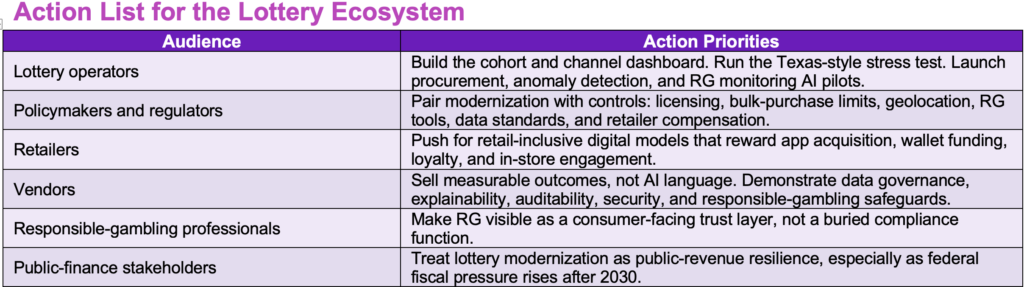
Operator takeaway. Stress-test a 20% gasoline-price shock against c-store traffic, instant-ticket sales, and beneficiary transfers. Build the cohort and channel dashboard before a legislature asks for it.
Policymaker takeaway. Flat transfers are not automatically a management failure. They may be a consumer-squeeze and modernization signal. Read the K-shape before writing the oversight letter.
2027-2031 Forward Look. Expect flat-to-modestly-down traditional sales absent another mega-jackpot cycle. Energy prices and trip frequency function as leading indicators for instant-ticket demand.
V. The Five-Front Competition for One Wallet
The lottery now faces five competitors for one discretionary dollar. The first battle is not cannibalization. The first battle is behavioral conditioning. Each competitor teaches consumers a different expectation about access, speed, odds, personalization, and social proof.
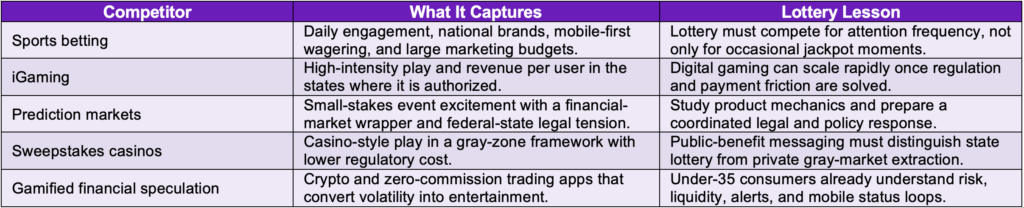
The lottery holds advantages the competition wants: state sanction, public-benefit funding, massive retail reach, known brands, and decades of political legitimacy. Its disadvantage is speed. Competitors iterate products in weeks. Lotteries must work through statutes, procurement cycles, budget processes, and multi-year contracts.
The strategic answer is not imitation. Commercial operators sell action. Lotteries sell action with public purpose. The work is translating lottery strengths into digital: small stakes, transparent odds, integrity, convenience, responsible-gambling architecture, and a distinct entertainment identity.
Operator takeaway. Study prediction-market mechanics as product research, not only as legal threat. Import the permissible elements: immediacy, transparency, social proof, simple mobile interaction, and rapid settlement where allowed.
Policymaker takeaway. A federally protected or gray-zone competitor that pays no state gaming taxes and carries no beneficiary obligation is a policy asymmetry, not merely a market outcome.
2027-2031 Forward Look. Courts, the CFTC, and Congress will fight over the prediction-market perimeter while products keep scaling. The under-35 habit battle is decided before the legal battle is complete.
VI. Trust as Infrastructure: Texas, Governance, and Responsible Gambling
Texas changed the industry’s psychology. A bulk-purchase scandal and courier controversy became a governance reset: the Texas Lottery Commission was abolished and state lottery functions transferred to the Texas Department of Licensing and Regulation effective September 1, 2025. The new regime also limits individual ticket purchases in a single transaction and prohibits facilitation of play through telephone, Internet application, or mobile Internet application. A limited-scope Sunset review creates continued scrutiny of the State Lottery Program.
The template for critics is now public: question integrity, then question access, then question the regulator. Every lottery should assume a single headline can become a legislative hearing.
The governance question has changed accordingly. It is no longer only, are we compliant. It is, could our structure survive a crisis. That question extends to cybersecurity, because lotteries combine money flows, consumer data, public trust, and high reputational risk.
Responsible gambling is the strategic answer, not the compliance afterthought. RG is one asset prediction markets, sweepstakes operators, and offshore books cannot easily match. Made visible to consumers and legislators, it becomes the sector’s trust brand: age verification, geolocation, play limits, self-exclusion, transparent odds, marketing controls, and evidence-based intervention.
The Lottery Trust Stack
- Game integrity and auditable game controls
- Age verification and identity assurance
- Geolocation and jurisdiction controls
- Bulk-purchase limits and unusual-purchase monitoring
- Retailer, courier, and insider-risk controls
- Cyber resilience and vendor incident disclosure
- RG monitoring and intervention protocols
- Auditable AI and transparent public-benefit reporting
Operator takeaway. Run the Texas-style stress test this fiscal year: bulk purchases, courier access, insider threats, cyber incidents, anomalous claims behavior, and emergency communications.
Policymaker takeaway. Fund controls before the crisis. Governance modernization is cheaper than governance reconstruction.
2027-2031 Forward Look. Visible controls become the license to operate. Age verification, geolocation, play limits, and auditable algorithms separate trusted platforms from political targets.
VII. Policy Intelligence as an Operating Capability
Policy is no longer background noise for lotteries. It is an operating variable that moves procurement costs, competitive boundaries, modernization timing, and trust obligations. The lotteries that treat regulatory intelligence as a growth capability, rather than a compliance memo, will move first when windows open.
Tariff Alpha: Procurement as Policy Risk Management
Tariffs do not target lotteries, but they price lottery operations. Section 232 steel and aluminum duties affect terminals, vending machines, shelving, signage, fixtures, and fleet costs. Section 301 duties on Chinese electronics affect displays, chips, payment hardware, and digital components. Paper-linked inputs matter because instant tickets remain physical products. The 2026 USMCA joint review adds a cross-border layer, because the instant-ticket supply chain uses Canadian pulp, specialty paper, and printing capacity.
The realistic risk is not a sudden supply halt. It is slow contract inflation as vendors price policy uncertainty into RFPs and escalation clauses. The countermeasures are contractual: tariff pass-through caps, duty-sharing provisions, change-of-law clauses, flexible source-of-origin language, and cooperative multi-state purchasing where statutes allow.
Regulatory Alpha: The Perimeter Fight Around Public Gaming
The regulatory center of gravity is shifting from lottery statutes to a broader digital-gaming perimeter. The CFTC’s June 10, 2026 proposed rule on event contracts involving enumerated activities would create a structured framework for assessing whether contracts involve gaming, war, terrorism, assassination, or unlawful activity, and whether they are contrary to the public interest. At the same time, litigation involving Kalshi shows the federal-state boundary remains unsettled. Kalshi has won important federal preemption arguments, but July 2026 rulings in New York and Washington show state gambling regulators are still very much in the fight.
Courier licensing and iLottery authorization remain state-by-state fights. Retailer revenue-sharing is the deciding political design feature in many of them. The election calendar sets the tempo. The 2026 state election cycle shapes governors, attorneys general, and legislative majorities. The 2028 presidential election shapes the federal referee: CFTC leadership, trade direction, AI posture, and tax priorities. The sector should prepare for policy regimes, not root for parties.
Operator takeaway. Maintain a live regulatory risk map covering couriers, iLottery, prediction markets, sweepstakes, RG mandates, data privacy, AI use, tariffs, and state election outcomes.
Policymaker takeaway. Model legislation should pair modernization with controls: licensing, bulk-purchase limits, geolocation, RG tools, data standards, and retailer compensation. That package passes more readily than bare digital expansion.
2027-2031 Forward Look. Expect additional iLottery authorizations, with outcomes decided by retailer inclusion and responsible-gambling design. The prediction-market classification fight will define the competitive perimeter for a decade.
VIII. Fiscal and Demographic Undercurrents
Two slow variables compound underneath everything else: the federal debt path and demographic turnover. CBO projects debt held by the public will rise from about 101% of GDP in 2026 to 120% in 2036, exceeding the prior post-World War II record. As fiscal pressure rises, every state revenue source becomes more politically valuable and more scrutinized.
In a fiscal-stress scenario, states protect beneficiary funding harder, which makes lotteries more strategically important, not less. It also raises the temperature on every integrity question, because a revenue source that matters more is watched more closely.
Demographic turnover hits the sector through three channels:
- Player base. The core player is aging while younger consumers are learning mobile-first speculation from sports betting, gaming apps, prediction markets, and financial-trading platforms.
- Retail footprint. Domestic migration changes where stores, players, and beneficiary needs are located, especially as population growth tilts south and west.
- Workforce. Lottery agencies are losing institutional knowledge just as they need digital-product managers, data scientists, cybersecurity specialists, procurement experts, and RG analytics teams.
The under-35 acquisition problem and the workforce problem are connected. Lottery must become an organization digital natives want to play with and work for.
Operator takeaway. Treat knowledge capture as urgent. Document processes in retiring heads before they leave and use AI to make that knowledge searchable, auditable, and durable.
Policymaker takeaway. Stress-test beneficiary funding against a post-2030 fiscal squeeze. States that modernize lottery revenue before the squeeze will have more options during it.
2027-2031 Forward Look. The fiscal reset arrives as the demographic handoff accelerates. Lotteries that solve under-35 engagement and institutional knowledge transfer before 2030 will be better positioned to fund public good through the stress.
IX. Agentic AI: The New Lottery Operating System
The AI infrastructure build-out reaches lotteries through state tax bases, residential electricity bills, cloud pricing, and talent-market competition. But the strategic story is what agentic AI can do inside the lottery. Lotteries run repeatable, rule-bound, auditable processes: procurement, claims, licensing, retailer compliance, legislative monitoring, financial reporting, audit preparation, security monitoring, and RG review. That is exactly the work agentic AI does well.
The Adoption Sequence: Integrity Before Marketing
The right sequence is the reverse of the commercial-operator playbook. Deploy AI first for efficiency, integrity, and responsible gambling. Deploy it cautiously, if at all, for player targeting. Opaque AI in player behavior scoring is the fastest route to a hearing. Explainable AI in RG and integrity monitoring is the fastest route to trust.

The Vendor Stack and the Buy-Outcomes Rule
The vendor ecosystem already covers most of the future lottery stack. Core platform providers such as Brightstar, Scientific Games, Pollard, Intralot, Allwyn, and Aristocrat Interactive can apply AI to operations and analytics. Engagement and digital firms can apply it to loyalty and product. RG, testing, and security firms can apply it to risk detection and certification. Retail media and in-lane providers can apply it to placement and merchandising. Enterprise AI providers, including Microsoft, Google, AWS, Anthropic, and OpenAI, sit behind many of these products.
The procurement rule is simple: buy outcomes, not buzzwords. Every AI contract should answer who controls the data, whether model outputs are retained, how decisions are audited, whether models train on lottery data, how a human review process works, and how the lottery can exit if the vendor or model changes.
Operator takeaway. Launch three FY2027 pilots: procurement and contract review, anomaly detection, and RG monitoring. Score every AI vendor on data rights, explainability, audit trails, RG controls, and proof of value.
Policymaker takeaway. Give lotteries explicit authority and budget for AI in integrity and RG. The alternative is a public gaming operator defending paper-era controls against AI-era threats.
2027-2031 Forward Look. AI assurance frameworks and certification become procurement table stakes. By 2030, the audit question is not whether a lottery uses AI. It is whether the lottery can explain what its AI did.
X. The Platform Answer: Retail-Inclusive Omni-Channel Lottery
The destination is a regulated omni-channel public gaming platform: eInstants, digital subscriptions, mobile wallets, loyalty programs, cashless payment, in-lane sales, self-service vending, retail media, and RG-by-design. The lottery of 2030 still funds public good. It just does not run a 1995 channel strategy to do it.
The political unlock is retail inclusion. Retailers are the lottery’s distribution partners and one of its most organized political constituencies. Every successful iLottery design should pair digital play with retailer commissions, lead generation, in-store wallet funding, or other forms of retailer participation so the store wins when the app wins.
The Retail-Inclusive iLottery Compact
- Retailer commissions or attribution for digital acquisition and reactivation.
- In-store wallet loading, cash-out, and identity verification where appropriate.
- QR-code loyalty tie-ins that connect counter, checkout, app, and retailer promotions.
- Shared promotions across counter, pump, checkout, app, and mobile wallet.
- RG-by-design controls built into the platform from launch.
- Public-benefit reporting that shows where digital growth supports state priorities.
Product design can import what competitors have proven without importing what they are. Immediacy, transparency, social proof, and simple mobile interaction can be adapted within lottery law and RG guardrails. Micro-jackpots, game-like experiences, and loyalty mechanics can retrain younger players without turning the lottery into a casino. The identity is the differentiator: small stakes, honest odds, public benefit.
Operator takeaway. Draft the retail-inclusive iLottery package now: digital authorization, retailer participation, RG-by-design, geolocation, age verification, data governance, and public-benefit reporting in one bill.
Policymaker takeaway. Frame online lottery as modernization of a public revenue platform, not imitation of casinos. Retail sharing and visible RG make it politically durable.
2027-2031 Forward Look. The best-run lotteries look less like product warehouses and more like public digital platforms with retail distribution. The gap between platform states and paper states becomes visible in beneficiary transfers.
XI. Conclusion and Action Framework
The through-line is that the variables lotteries once treated as fixed have moved at the same time. The retail monopoly on convenience gaming is gone. Jackpots no longer market the category for free. Paper is no longer enough as the security model. Compliance is no longer enough as the trust strategy. Meanwhile, a squeezed consumer, pump-price volatility, fiscal pressure, and demographic turnover compound quietly underneath.
Decision-makers should hold three scenarios in view:
- Base case: slow re-platforming. Traditional sales are flat, iLottery expands gradually, and competitors continue to scale.
- Structural-break case: retail-inclusive iLottery, AI integrity tools, and RG-as-trust accelerate modernization and re-rate the leaders.
- Risk-materializes case: an integrity scandal, expanded prediction-market preemption, or fiscal stress hits beneficiary funding and forces a harder reckoning.
The future is not to become a sportsbook, a casino, or a prediction market. The future is to become the most trusted, public-benefit version of digital gaming before someone else trains the next generation of players.
The future is not to become a sportsbook, a casino, or a prediction market. The future is to become the most trusted, public-benefit version of digital gaming before someone else trains the next generation of players.
Questions Every Stakeholder Should Ask
- Could the lottery’s governance structure survive a crisis, and how would stakeholders know?
- What is the under-35 acquisition plan, and what does the cohort data say today?
- Who controls the data inside vendor products, and how are AI decisions audited?
- What is the beneficiary story under a post-2030 fiscal squeeze?
- What stops, and who knows first, if the largest printer, platform, payment processor, or cloud region fails for a week?
- Is responsible gambling visible to consumers and legislators, or buried in compliance?
- Does the digital strategy help retailers win, or ask them to accept their own disintermediation?
Final thought: The lottery is not dying. It is being re-platformed. The organizations that understand the difference will define public gaming’s next decade.
Selected Sources and Notes
[1] NASPL Insights, “A Challenging Year, With an Asterisk,” FY2025 U.S. lottery sales of almost $109.4B, down $4B or 3.6%.
https://www.nasplinsights.com/post/a-challenging-year-with-an-asterisk
[2] American Gaming Association, “Commercial Gaming Revenue Hits $78.7 Billion in 2025,” commercial gaming revenue of $78.72B, sports betting revenue of $16.96B, iGaming revenue of $10.74B.
https://www.americangaming.org/commercial-gaming-revenue-hits-78-7-billion-in-2025-driving-record-18-1-billion-in-gaming-taxes-nationwide/
[3] Pew Research Center, prediction-market volume data for Kalshi and Polymarket, April 2026 monthly volume around $24B.
https://www.pewresearch.org/short-reads/2026/05/27/trading-volume-on-prediction-markets-has-soared-in-recent-months/
[4] Commodity Futures Trading Commission, June 10, 2026 NPRM on event contracts involving enumerated activities.
https://www.cftc.gov/PressRoom/PressReleases/9249-26
[5] Texas Department of Licensing and Regulation, history page summarizing SB 3070 transfer of lottery and charitable bingo responsibilities to TDLR effective September 1, 2025.
https://www.tdlr.texas.gov/history.htm
[6] Reuters, July 2026 Kalshi litigation coverage, including Washington and New York rulings involving state gambling-law enforcement.
https://www.reuters.com/legal/government/washington-judge-blocks-kalshi-contracts-cites-states-gambling-law-2026-07-21/
[7] Congressional Budget Office, The Budget and Economic Outlook: 2026 to 2036, federal debt held by the public rising to 120% of GDP by 2036.
https://www.cbo.gov/publication/62105
[8] NASPL Insights, “Redefining Lottery Retail,” U.S. instant-ticket sales exposure to gas and c-store retailers.
https://www.nasplinsights.com/post/redefining-lottery-retail
[9] NASPL FAQ, FY2024 U.S. lottery sales and beneficiary transfers, retailer and responsible-gambling context.
https://www.naspl.org/faq
[10] NACS, Key Facts About Fueling, convenience-store fuel-channel data and inside-store conversion context.
https://www.convenience.org/topics/fuels-and-energy/the-us-petroleum-industry-statistics-definitions
[11] NACS, U.S. convenience-store industry sales and transaction data for 2025.
https://www.convenience.org/stay-current/press-releases/2026-press-releases/u-s-convenience-in-store-sales-top-%24340-billion
[12] NACS, “What Does the Future of Lottery Look Like?,” retail integration and checkout-lane modernization context.
https://www.convenience.org/stay-current/news/2025/september/15/5-what-does-the-future-of-lottery-look-like_tech