


AI infrastructure economics drive AI success
By now, your company has some kind of AI strategy. The BoD is demanding ROI from it. Your competitors are piling into it. But most of the executives cheerleading it can’t name the handful of companies that decide whether it actually happens.
It ain’t a knowledge gap. It’s a strategic risk. Every model, every data center, every agent, every robot on the roadmap sits on top of a physical stack: logic, memory, packaging, networking, power, capital. Miss one layer and the whole plan stalls out like the second season of your favorite Netflix series.
Here’s the shift for 2026. AI strategy is now infrastructure strategy, and the scarce thing is no longer one thing. The bottleneck keeps moving. It started at leading-edge logic, then jumped to high-bandwidth memory, then to advanced packaging, and now, increasingly, to power for data centers. A plan fails wherever the next constrained piece shows up late. The winners won’t be the companies with the flashiest model or the biggest chip order. They’ll be the ones who get the whole stack to the same place at the same time.
Why This Matters
- Your AI roadmap rests on a concentrated stack, not a single chip. There’s no one chokepoint. There are several. Logic, memory, packaging, and power each have highly concentrated supply and long, slow expansion cycles.
- Memory and packaging can stall you even when the chip is sitting on the dock. Micron has already locked the price and volume of its entire 2026 HBM supply. SK hynix says demand outruns what it can make. TSMC says its packaging capacity is so tight it’s limiting customers’ growth. The accelerator is only half a system.
- Custom silicon diversifies your design, not your dependence. A hyperscaler can build its own chip to escape one vendor and still land right back in the same foundry, memory, and packaging ecosystem as everyone else.
- Scarcity is information. Whatever is being rationed today is the market telling you where value and capital are moving next. Read it as a signal, not an annoyance.
- The bottleneck keeps moving. The game isn’t predicting one permanent shortage. It’s building enough flexibility to adapt as the constraint jumps from layer to layer.
- Every constraint is a new market. HBM, packaging, power systems, cooling, optical networking, robotics, domestic fabs. Each shortage is someone’s growth story.
Core thesis: Scarcity tells you where today’s problem is. Synchronization tells you who solves tomorrow’s.

The Framework: The Scarcity Stack
Picture the AI economy as a stack. At each layer, ask one question: who controls whether the next layer can scale? The higher you look, the more competition you see. The lower you look, the more concentration, capital intensity, and lead-time risk. Most strategy conversations happen at the top, where the money and headlines are. The leverage lives at the bottom, where the scarcity is. I call it the Scarcity Stack.
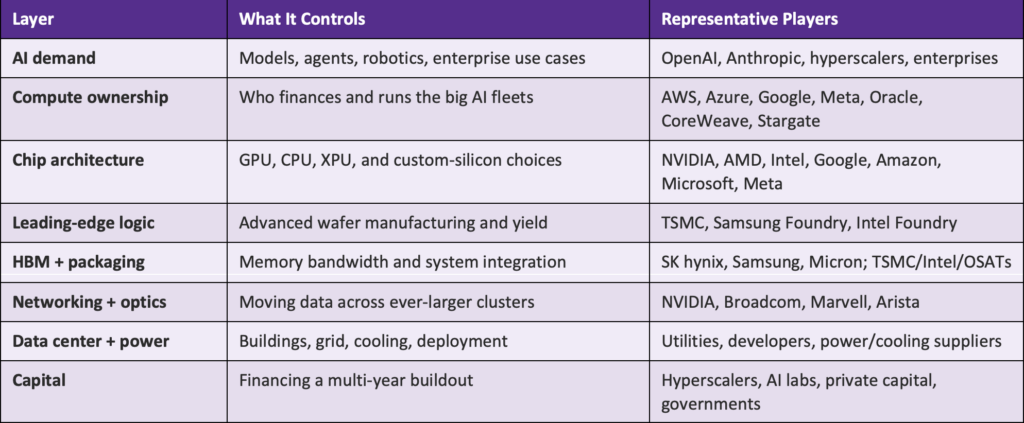
The Concentration Paradox
TSMC sits at the center of the leading-edge world, and its business model is the reason why: it makes chips for customers who are at each other’s throats on everything else. NVIDIA, AMD, and a pack of hyperscalers chase completely different architectures and still depend on the same manufacturing base. TSMC is spreading out geographically, but the most advanced capacity stays concentrated in Taiwan, and it takes years to build, qualify, and ramp fabs.
Now the twist. Over the last three years, the biggest tech companies set out to reduce their dependence on the dominant chip designer by rolling their own silicon. Google, Amazon, Microsoft, Meta, each with a custom accelerator. On paper, diversification. In practice, the opposite. More competition in chip design doesn’t buy more diversification in manufacturing. You can design your own chip to dodge one vendor and stay exposed to the very same foundry, memory, packaging, and power constraints as your rivals.

The Bottleneck Keeps Moving
Leading-edge logic is just the first wall. An accelerator has to be married to memory, wrapped in advanced packaging, wired into a network, and fed enough power to run at scale. The economics look less like a chip and more like a fleet. Any missing part delays the deployment and strands the capital. And throwing more money at it doesn’t fix the constraint. Sometimes it makes it worse.
HBM: The Memory Wall
High-bandwidth memory is what keeps an AI chip fed. Starve it and the most advanced processor on earth sits there idling. Three companies make it: SK hynix, Samsung, and Micron. Micron has already contracted the price and volume of its entire 2026 HBM supply. SK hynix said in July 2026 that demand runs past what it can produce. That doesn’t mean every unit from every supplier is gone. It means the market is brutally tight and leaning on a very short list of producers. Ask yourself why memory companies are posting the fattest margins in the industry’s history. That’s scarcity, on an income statement.
Advanced Packaging: The Integration Wall
The chip stopped being the product. The integrated system is the product. Advanced packaging is what crams logic and stacks of memory close enough to talk at absurd bandwidth. TSMC told investors in July 2026 that its packaging capacity is tight enough to limit customers’ growth. It even welcomed rivals adding packaging capacity, because more packaging elsewhere means more of TSMC’s own wafers can become finished systems. When the market leader roots for competitors, you know the constraint is real.
Memory Spillover: Why Your Laptop Got Pricier
AI doesn’t reach into your phone and yank out its memory chip. The spillover is subtler. High-value HBM soaks up capital, clean-room space, equipment, and engineering attention. As suppliers tilt toward AI, the balance for ordinary DRAM tightens too. In effect, your laptop’s memory is competing for fab capacity and capital with the AI boom, and losing. A constraint buried deep in the AI stack ends up on a consumer price tag and drives inflation.
Networking: The Data-Movement Wall
Here’s the part almost nobody outside the industry sees coming, and it may be the next bottleneck of all. Once you have the chips, the memory, and the packaging, you still have to move data between thousands of processors. That is becoming its own wall. As AI clusters grow, the electrical wiring that shuttles data between chips burns more power and throws off more heat the faster and farther it has to go. At some point, copper stops keeping up.
The fix is light. Silicon photonics moves data as photons instead of electrons. It carries far more information, at higher speed, using less power, over the distances a modern AI cluster needs. It already runs the optical links between servers and racks. Now it’s moving closer to the chip itself. The AI factory is quietly becoming a race to move data, and increasingly that means light. This is the leading edge of where chips are headed.
This is why the “fastest chip” framing misses the point. Compute, memory, packaging, networking, and power all have to scale together. The slowest link sets the speed of the whole system. A world-beating processor that can’t get data in and out fast enough is just an expensive space heater.
Power: The Next Wall
The semiconductor bottleneck is quietly becoming an infrastructure bottleneck. More accelerators mean more racks. More racks mean more cooling, transformers, substations, and generation. A data center that gets its chips before it gets its power isn’t an AI asset. It’s an expensive warehouse. For corporate planners, grid access and deployment timing are now part of the compute equation, whether they signed up for it or not.
Capital: The Deepest Wall
Follow the bottleneck all the way down and you arrive at money. The AI buildout has outgrown corporate cash flow, so the industry is moving from spending cash to raising debt. Analysts estimate the largest cloud players are now plowing the vast majority of their operating cash flow into capital spending, and AI-related borrowing has become a heavy share of new investment-grade corporate debt in the U.S. When the biggest, richest companies in the world start borrowing to keep up, that’s the constraint talking.
Then the market got creative. In August 2026, NVIDIA and a group of Wall Street firms unveiled a plan to mobilize on the order of $500 billion in third-party capital to finance its customers’ data centers and chip purchases. The mechanism is the tell: advanced computing hardware gets treated as a new asset class, collateral you can lend against like commercial real estate. If a borrower defaults, the chips get re-rented to someone else. Scarcity has become so valuable that the shortage itself is being turned into something you can securitize.
The other half of the story is equity. In June 2026, Alphabet raised roughly $49.5 billion in new equity and equity-like capital, with AI infrastructure among the stated uses. Sit with that. Alphabet generates cash like almost no company in history, and it still reached for outside money. Why? It spent $80.6 billion on capex in the first half of 2026 alone, more than double the year before. CoreWeave, IREN, and Nebius are running smaller versions of the same play. Here’s the problem for every stockholder: more supply. Equity is the healthier way to fund a buildout this size, because it doesn’t have to be paid back on a schedule the way debt does. But every new share dilutes the ones already out there. More issuance is good news for the buildout and a quiet cost to the people who already own the stock. Funding the future and diluting the present are the same transaction.
That is either the financial engineering that funds the future or the leverage that amplifies the fall. Reasonable people can disagree. The bullish read: capital is simply doing its job, routing money to the most productive use of the decade. The cautious read: some analysts point to circular arrangements, where a chip vendor helps finance the very purchases of its own chips, and to billions in off-balance-sheet commitments that can obscure the true risk. One estimate puts the ecosystem’s total debt needs above $2 trillion, more than traditional bond markets may be able to absorb, which pushes the rest into private credit and purpose-built financing platforms. However it plays out, the point for a corporate planner is the same: the capital layer now moves with the same scarcity logic as silicon. It’s the one layer that can seize up all the others at once.

Scarcity Creates Innovation
Scarcity isn’t a dead end. It’s a forcing function. When the most valuable input in the economy gets rationed, capital and innovation attack the constraint from every angle. Three of those attacks are already redrawing the map.
1. China Is Building Its Own Stack
Export controls didn’t kill China’s chip ambitions. They redirected them. The rules still restrict advanced-computing exports and require licenses for many China-linked buyers, even after products like NVIDIA’s H200 and AMD’s MI325X moved to case-by-case review under 2026 policy. China’s answer is localization: domestic chips, tools, software, and fabs built to be good enough for a market it controls. Key point: they don’t need to beat the leader. They need to be sufficient. Don’t assume China has to reach frontier parity to matter. A prudent 2030 base case is partial bifurcation: a frontier ecosystem around U.S.-aligned tech and TSMC, and a Chinese ecosystem increasingly able to serve its own demand and a few friendly markets. And Chinese open-weight models are already good enough that Western companies are quietly using them. That is what sufficient looks like in practice.
2. Efficiency Is Attacking the Cost of Intelligence
When compute gets expensive, engineers optimize around it. Model compression, smarter inference, workload routing, custom silicon, better software. Each one cuts the cost of a useful AI result. That sets up a Jevons-like rebound: drop the cost per unit of intelligence far enough and you unlock whole new uses that were never affordable before, so total demand can climb even as each task gets cheaper. The right question stopped being “how many GPUs do we have?” It became “what delivers the cheapest sufficient intelligence for this workload?”
3. AI Is Leaving the Data Center
The first wave of AI lived in the cloud. The next one walks, drives, and flies. Robots, autonomous vehicles, industrial machines, and smart edge systems need a mix of leading-edge compute and mature, specialty chips for sensors, power management, connectivity, and control. In July 2026, Mitsubishi Motors and Highlanders announced an agreement to explore humanoid-robot development and the feasibility of building them in unused space at Mitsubishi’s Kyoto plant starting in early 2027. When an automaker starts eyeing empty factory buildings for humanoid production, physical AI stops sounding like science fiction and starts looking like industrial strategy.
This is the semiconductor barbell. Frontier logic, CPUs, GPUs, XPUs, and advanced memory at one end. Power-management chips, sensors, and control silicon at the other. Physical AI grows demand at both ends at once, and a lot of it lands on the mature nodes everyone forgot to worry about.

What This Means If You Don’t Buy Chips
Most executives will never haggle with a foundry. That doesn’t make any of this someone else’s problem. Your exposure shows up as cloud pricing, capacity you can’t get, automation economics, vendor concentration, and the timing of your capital projects. For most companies, semiconductor scarcity arrives as an economics problem long before it looks like a procurement problem.
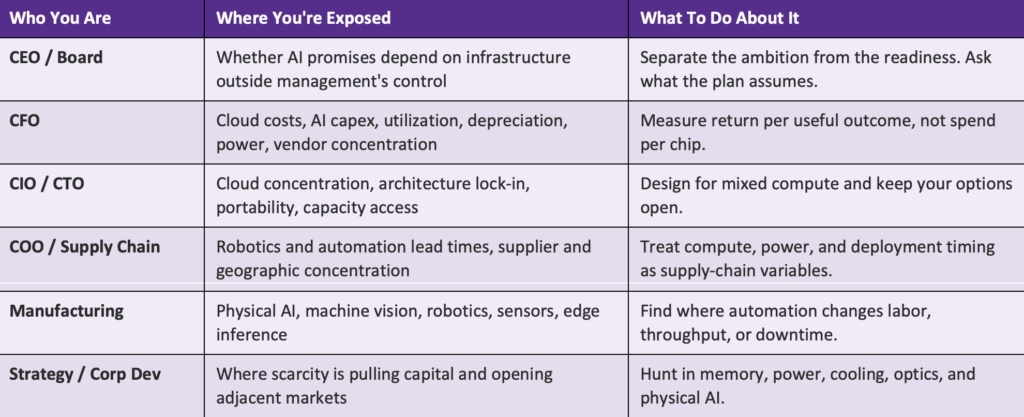
Five Planning Lenses for the C-Suite
Lens 1. Map the dependency before you scale the ambition. Find where your AI strategy touches the stack: cloud, architecture, memory, network, power, geography, vendors. The answer changes what you should promise and how fast.
Lens 2. Watch the next constraint, not the last one. Logic might be plentiful while memory, packaging, grid access, or construction runs late. Ask what happens if each critical layer shows up six to twelve months behind plan.
Lens 3. Put a price on resilience. A second cloud, a backup architecture, a geographic option, a second supplier. All look wasteful on a spreadsheet right up until your primary path jams. Optionality has a value. Name it.
Lens 4. Measure the economics that matter. Track useful intelligence per dollar, per watt, and per month of deployment time. Utilization and time-to-value count as much as peak performance on a spec sheet.
Lens 5. Follow the scarcity to the growth. Watch where the capital is rushing to break the bottleneck. HBM, packaging, networking, power, cooling, robotics, domestic fabs. Today’s constraint is tomorrow’s growth market.
The Bottom Line
The AI economy doesn’t have one permanent point of failure. It has a moving set of concentrated chokepoints. Logic gets scarce, then memory, then packaging, then networking, then power, and finally the capital to pay for all of it. The whole thing works only when enough of the stack shows up in the same place at the same time.
That changes the job. The next phase of AI won’t be won by whoever has the best model or the biggest chip order. It’ll be won by whoever can synchronize compute, memory, networking, power, capital, and deployment faster than the competition, and still keep enough slack to adapt when the bottleneck moves again. Because it will.

The question isn’t whether your company has an AI strategy.
It’s whether that strategy can see the bottlenecks coming. And survive contact with the infrastructure it depends on.