

Post-Peak Trump: Not Decline, Disorder
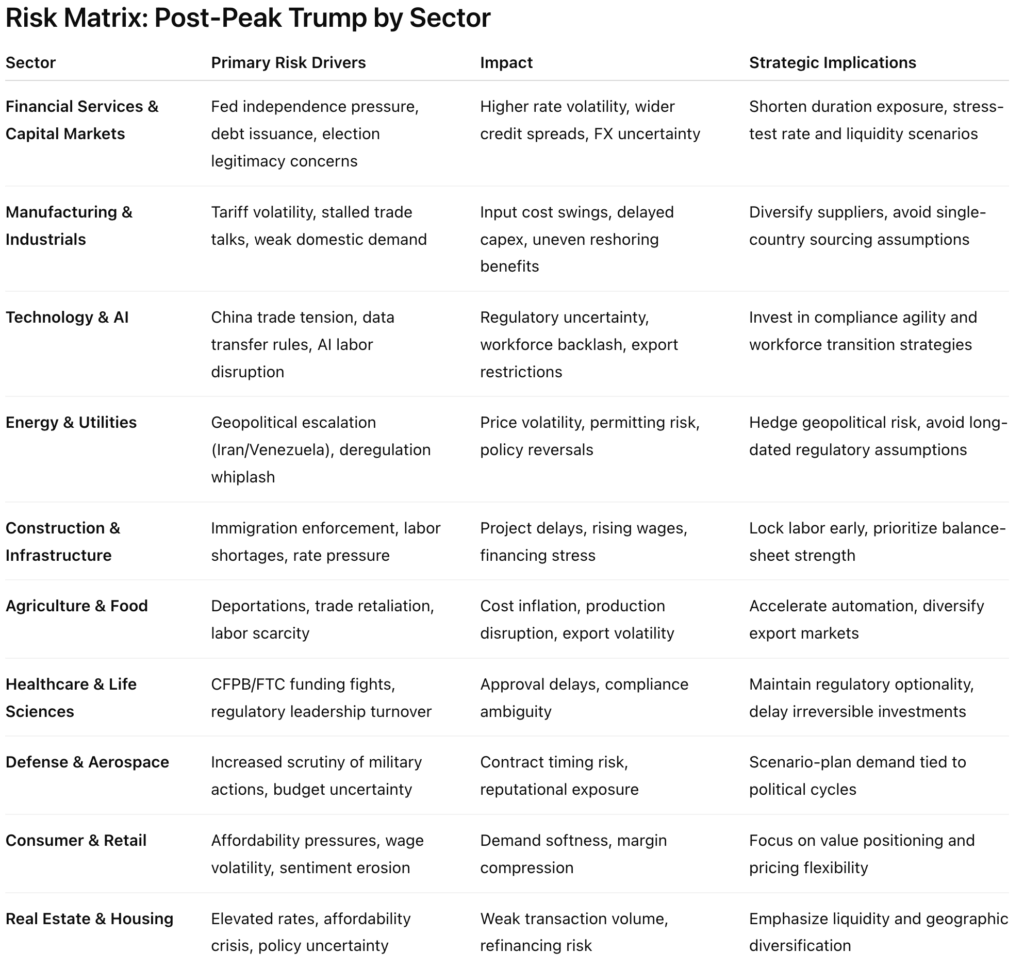
Andy Note: I’ve created this piece not as our typical deep dive, but as an outline to be shared and debated. These are my Christmas cookies and coffee fueled thoughts on what will happen in 2026 on the biggest risk I see. The bonus in this piece is sector risk matrix and strategies (at the bottom) I normally only share with clients during my keynotes.
Welcome to 2026!
I. What “Post-Peak Trump” Actually Means
The Core Concept:
The United States is entering a post-peak Trump phase. This isn’t because Donald Trump has lost power, but because the marginal effectiveness of his executive authority is beginning to slide.
This is not a retreat from power. It is a transition from:
- Expansion → friction
- Control → resistance
- Certainty → volatility
Peak Trump was defined by rapid consolidation of authority, compliance by institutions, and shock-and-awe policymaking. Post-peak Trump is defined by institutional drag, legal pushback, political leakage, and credibility erosion. All this occurs while Trump remains highly aggressive and uses the full extent of executive power.
Key implication:
This phase produces heightened uncertainty for businesses, markets, capital allocation, trade, labor, and geopolitical alignment.
II. Congressional Slippage: Early Signs of Institutional Resistance
A. House and Senate Dynamics
- Discharge petition risk: Even four Republican defections now matter, signaling weakening caucus discipline. Epstein files release demonstrate the limits of MAGA base with Trump administration and points the way to more actions.
- Public dissent from figures such as Boebert and Marjorie Taylor Greene reflects fracturing populist alignment, not ideological moderation. The topic of affordability is a great example of the disconnect. Boebert claiming retaliation by Trump due to his veto for clean water in CO is another demonstration of the fissure.
- If Democrats retake the House, oversight risk explodes:
- Subpoenas
- Hearings
- Staff exits driven by legal exposure
- Strategic non-cooperation by DOJ creating constitutional standoffs
Negative outcome extension:
Markets begin pricing legislative paralysis risk and inability to deal with a potential fiscal crisis, even as executive actions continue. This can create policy whiplash without durable outcomes.
III. DHS, ICE, and DOD: Power Exercised, Legitimacy Eroded
A. Immigration Enforcement Optics
- With increased funding by Congress, aggressive DHS and ICE actions generate constant media coverage.
- Deportation errors involving naturalized citizens or legal residents represent a trust-destroying event, not merely a legal failure.
- Labor-intensive sectors (construction, agriculture, hospitality) face workforce disruption, wage spikes, and compliance uncertainty.
Second-order risk:
State and local governments quietly resist enforcement (Ex: Chicago, Portland), creating uneven application of federal authority. California likely leads the way with new NYC Mayor Mamdani moving against any Trump Adm actions.
B. Department of Defense Pressure Points
- Military actions (Venezuela, Cuba, Greenland, Columbia, Mexico, Iran) eventually require public justification amid growing skepticism. Pottery Barn analogy: you break it, you own it.
- Military actions increasingly perceived as political distraction, not strategic necessity by the MAGA base in Congress.
IV. Judicial Headwinds: Courts as a Brake, not a Block
A. 2025 Rulings Against the Administration
- National Guard deployment limits
- Habeas corpus protections
- Partial rejection of birthright citizenship reinterpretation
B. 2026 High-Risk Cases
- IEEPA scope and abuse
- Firing of independent agency officials (FTC and Fed)
- CFPB funding
- Voting rights and Section 2 enforcement
- Mail-in ballot deadlines
- Federal vs. state court jurisdiction shifts
Institutional dynamic:
The Supreme Court of the United States does not remove power—it slows it. That delay alone increases uncertainty premiums across the economy. Lower courts more aggressive in denial of Trump actions.
V. Trade, Tariffs, and FDI: Negotiation Fatigue Sets In
A. Stalled Trade Architecture
- USMCA renegotiation delayed despite statutory timelines.
- US-EU Transatlantic talks show no progress.
- Section 301 actions on logistics and shipbuilding raise costs without strategic clarity.
B. China Flashpoints
- Tariff freezes expire in late 2026.
- China’s rare earth export control suspension ends.
- Escalating tension over:
- Digital platforms
- Data transfers
- Taiwan arms sales
New negative outcome:
Foreign direct investment pledges become non-binding signaling tools, not deployable capital, as firms wait for policy clarity. Think slow-roll, not fast break.
VI. Economy: Affordability, Rates, and Structural Drag
A. The Affordability Disconnect
- Public statements dismissing affordability concerns alienate low- and middle-income voters.
- Housing prices remain elevated even if inflation moderates.
- Electricity prices become a flash point against AI and data centers.
- HC ACA costs soar.
- Mortgage rates stay high due to:
- Large Treasury issuance
- Global sovereign borrowing
- Tech sector debt supply
B. Manufacturing and Labor Reality
- Manufacturing job growth underperforms rhetoric.
- AI adoption disproportionately affects:
- Entry-level roles
- College graduates
- White-collar back-office functions
Extended risk:
The administration is blamed for technological displacement it did not create, accelerating political backlash.
VII. Federal Reserve Tension
- Pressure to appoint a more dovish Fed chair increases.
- Rate cuts may arrive—but risk being seen as politically compromised.
- Loss of perceived independence at the Federal Reserve raises:
- Inflation risk premiums
- Dollar volatility
- Bond market skepticism
VIII. White House Internal Fractures
- Normal staff turnover accelerates due to:
- Family pressure
- Legal risk
- Career preservation
- Leaks become a strategic weapon between factions.
- Cabinet authority weakens as loyalty tests replace competence signals.
- MAGA podcasters turn aggressively against policies.
Net effect:
Execution quality declines even as executive orders increase. Power increases in Trump but risk of policy error due to “yes” men.
IX. Escalation Scenarios: How Post-Peak Trump Could Turn Darker
Additional negative pathways clients should monitor:
- Election Legitimacy Crisis
- Ballot rule changes
- Federal intervention rhetoric
- Markets price constitutional uncertainty
- National Emergency Expansion
- Broader military authority
- Domestic deployment normalization
- Tariff Volatility as Fiscal Tool
- Tariffs used to fund targeted spending (ex: military bonuses)
- Retaliation risk accelerates
- Congressional Non-Recognition
- Administration refuses testimony
- DOJ shields officials
- De facto separation-of-powers breakdown
- Geopolitical Shock Absorption
- Iran or Venezuela escalation
- Ukraine disengagement, Russia rapprochement
- Strategic ambiguity on Taiwan raises risk
X. Strategic Takeaways
Post-Peak Trump is not weakness, but instability with authority.
For businesses, investors, and global partners, this period is defined by:
- Higher volatility premiums
- Lower policy durability
- Faster narrative shifts
- Increased institutional conflict
The risk is not that Trump fades but that the system around him stops absorbing shocks efficiently.
Bonus: risk matrix for top economic sectors and strategies to deal w/Post-Peak Trump.