


How blockchain tokenization and AI are reshaping the architecture of global capital markets
Okay, I get it. I’m late to the game on this, but it’s extraordinary. The 5x rise in RobinHood since April caught my attention and tells you everything you need to know about the forward momentum on tokenization. I thought it would be helpful to combine tokens with AI to show where this is going.
Below is a brief, but deep explainer on what is happening and what the future holds.
Executive Summary
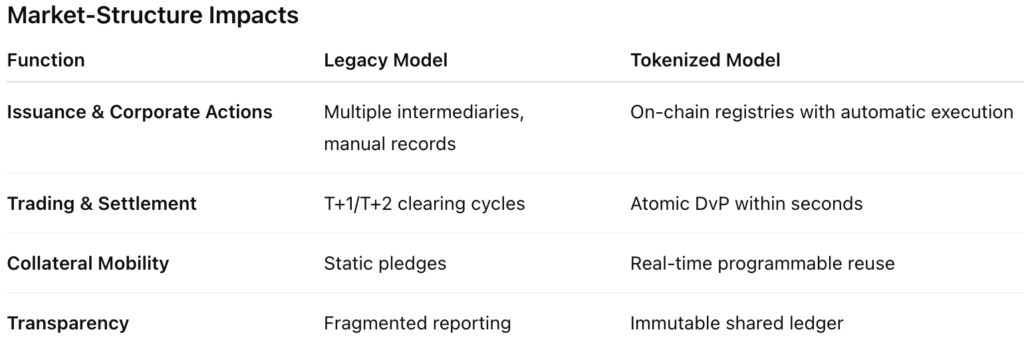
Tokenization converts traditional securities—such as corporate stock—into digital tokens recorded and transferred on a blockchain. This shift does not alter what a stock is; it transforms how it is issued, traded, settled, and custodied.
At the same time, artificial intelligence (AI) is revolutionizing how these systems are operated, monitored, and optimized. Together, tokenization and AI are creating a financial ecosystem that is faster, more transparent, and increasingly autonomous.
The near-term impact: instant settlement, lower operational costs, and programmable compliance.
The long-term transformation: markets that trade continuously and manage themselves through data-driven intelligence.
Part I – Tokenization of Stocks
Definition and Regulatory Context
Tokenization records ownership of securities on distributed ledgers rather than in centralized databases.
According to SEC Commissioner Hester Peirce, “tokenized securities are still securities,” and therefore remain subject to federal registration, disclosure, and antifraud requirements 【SEC 2025】.
Smart contracts can automatically process dividends, voting rights, and ownership transfers—reducing reconciliation errors and enhancing transparency 【Ropes & Gray 2025】.
Why the Transition Is Accelerating
- Institutional validation.
BlackRock’s BUIDL and Franklin Templeton’s BENJI tokenized money-market funds proved that blockchain vehicles can function inside existing regulation, together surpassing $1 billion AUM in 2025 【BlackRock 2025】【Franklin Templeton 2024】. - Regulatory flexibility.
The SEC’s July 2025 statement encouraged controlled pilots while maintaining traditional investor protections 【SEC 2025】. - Post-patent innovation.
Vanguard’s ETF share-class patent expired (2023), enabling competitors to merge mutual-fund and ETF structures within tokenized frameworks 【FT 2024】. - Efficiency pressure.
The BIS has noted that “tokenization could enable near-instantaneous delivery-versus-payment, releasing capital tied up in settlement lags.” 【BIS 2024】
Regulatory Posture
The SEC applies a “same activity, same risk, same rule” standard. Tokenized assets must:
- Register or qualify for exemption under the Securities Act;
- Trade through registered exchanges or ATS platforms;
- Maintain qualified custody and investor protection.
The IMF notes that tokenization could enhance efficiency but cautions that governance, privacy, and cyber-risk management are prerequisites for large-scale adoption 【IMF 2024】.
Adoption Outlook (2025–2030)
- Tokenized cash and Treasuries as settlement assets.
- Private-market shares and fund interests on permissioned blockchains.
- Public equities integrated once exchanges and clearing utilities support atomic settlement.
Part II – AI and Tokenization: The Convergence That Will Redefine Market Structure
Overview
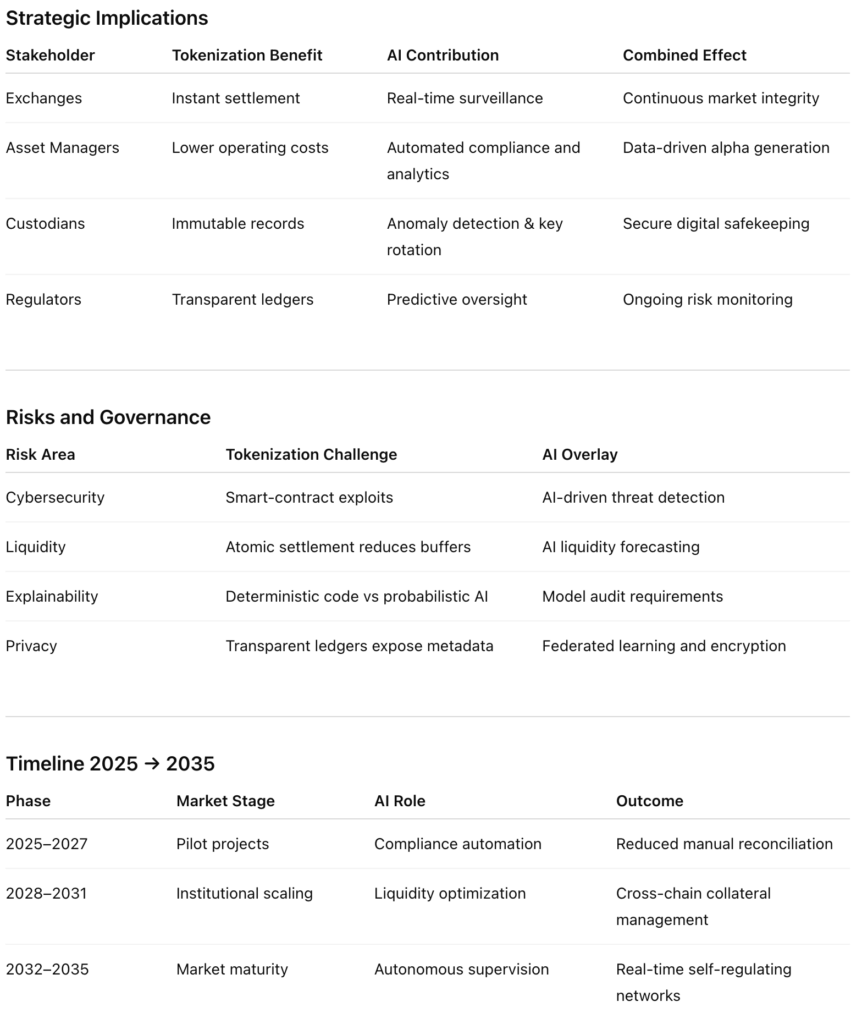
AI is becoming the operational layer that controls, audits, and optimizes tokenized markets.
J.P. Morgan’s 2025 report on tokenized assets concluded that “AI and machine learning will be essential for scalability, monitoring, and liquidity provision in 24/7 markets.” 【J.P. Morgan 2025】
1 – AI in Market Infrastructure
- Smart-contract auditing: LLM-based code review tools detect vulnerabilities before deployment.
- Automated reconciliation: AI matches on-chain and custodial records instantly.
- Predictive compliance: Anomaly detection identifies suspicious wallet activity in real time 【Ropes & Gray 2025】.
The result is a dramatic reduction in operational errors and faster incident response.
2 – AI in Trading and Liquidity
Reinforcement-learning algorithms optimize execution across global venues that never close.
The BIS has observed that machine-learning-based market makers could “stabilize liquidity in continuous tokenized markets while maintaining tight spreads.” 【BIS 2024】
3 – AI in Risk and Collateral Management
AI agents evaluate tokenized collateral in real time and redeploy assets to minimize funding costs.
ISDA (2025) reports that atomic settlement combined with AI optimization could reduce counterparty exposure by 30–40 percent 【ISDA 2025】.
4 – AI in Governance and Regulation
Regulators are experimenting with AI simulation and natural-language processing tools to stress-test tokenized ecosystems and analyze smart-contract disclosures 【SEC 2025】.
The IMF adds that “AI can augment oversight capacity in real time, but requires strong data-governance and ethical frameworks.” 【IMF 2024】
The Macro Perspective
Tokenization modernizes the rails of finance; AI modernizes the intelligence that runs across them.
Regulators such as the BIS and IMF describe this fusion as a pathway to a more efficient and resilient market infrastructure—provided that governance and data standards keep pace 【BIS 2024】【IMF 2024】.
Together, these technologies are transforming capital markets from periodic, human-supervised processes into continuous, data-driven systems capable of instant settlement and constant compliance.
References
- SEC (2025). Commissioner Hester Peirce, Statement on Tokenized Securities, July 9 2025. https://www.sec.gov/newsroom/speeches-statements/peirce-statement-tokenized-securities-070925
- Yahoo Finance (2024). Wall Street and Crypto Industry Say Tokenization Will Reshape Global Markets. https://finance.yahoo.com/news/wall-street-crypto-industry-say-tokenization-will-reshape-global-markets-its-going-to-eat-the-entire-financial-system-133005463.html
- BlackRock (2025). BUIDL Fund Overview. https://www.blackrock.com/us/individual/products/344413/buidl-fund
- Franklin Templeton (2024). On-Chain U.S. Government Money Fund (BENJI). https://www.franklintempleton.com
- Financial Times (2024). Vanguard’s ETF Patent Expiry Opens Door for Industry.
- J.P. Morgan (2025). Tokenized Assets and Market Structure. https://www.jpmorgan.com/insights/securities-services/custody/tokenization-real-world-assets
- Bank for International Settlements (2024). Tokenization and the Future of Market Infrastructure. https://www.bis.org/publ/qtrpdf/r_qt2406g.htm
- Ropes & Gray (2025). Legal and Operational Considerations for Tokenized Securities.
- International Monetary Fund (2024). Tokenization: From Asset to Infrastructure. https://www.imf.org/en/Publications/fintech-notes/Issues/2024/06/10/tokenization-from-asset-to-infrastructure
- International Swaps and Derivatives Association (2025). Atomic Settlement and Counterparty Risk in Tokenized Markets.